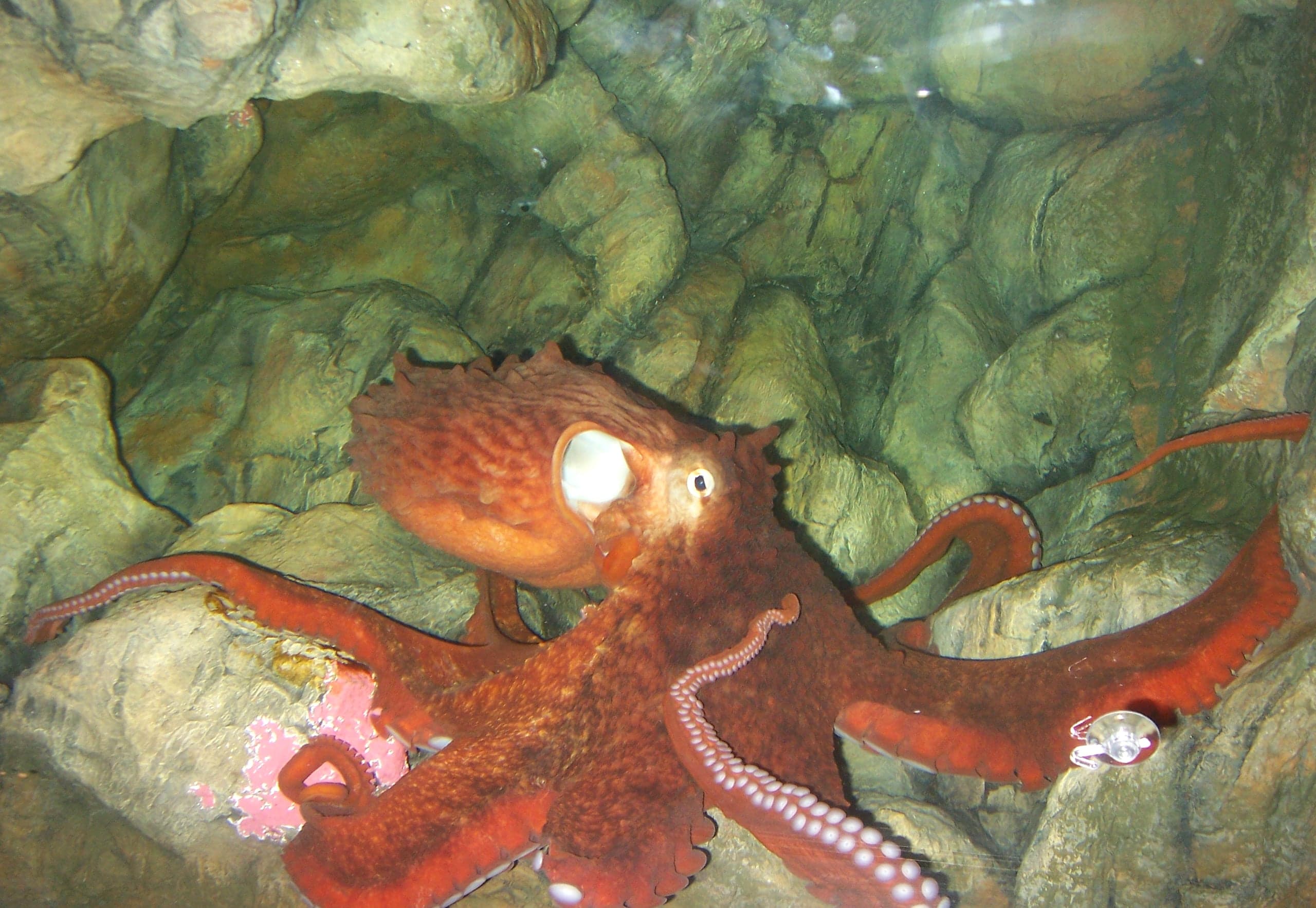
Play is something we usually associate with puppies, kittens, crows and children. It turns out octopuses do it too.
The bottle game
In a study of giant Pacific octopuses, researchers placed floating pill bottles in their tanks. At first, the octopuses explored the bottles the way they would anything new. Then some of them started doing something else. They used jets of water to push a bottle across the tank and into the current, which carried it back to them, again and again. Source Mather et al., 1999(opens in a new tab)
That's not feeding, and it's not escaping. It looks a lot like play.
Lego, on purpose
A later study gave common octopuses Lego pieces alongside food. Nine of the fourteen octopuses showed play-like behavior with the Lego. Source Kuba et al., 2006(opens in a new tab)
Interestingly, play didn't show up on the first day. It appeared mostly on days three to six, after the octopuses had finished exploring the objects and got used to them. Whether they were a little hungry or well fed made no significant difference, and neither did their age or sex. Source Kuba et al., 2006(opens in a new tab)
Why it matters
The researchers noted that octopuses almost certainly evolved play independently from vertebrates, since our last common ancestor likely lacked the capacity for it. Source Kuba et al., 2006(opens in a new tab)
In other words, play has evolved more than once. And one of those times, it was in an octopus.
Bucky saysLiked this? Becoming an Octopedarian takes about 20 seconds. Join the movement
Sources
- Kuba, M. J., Byrne, R. A., Meisel, D. V., & Mather, J. A. (2006). When do octopuses play? Effects of repeated testing, object type, age, and food deprivation on object play in Octopus vulgaris. Journal of Comparative Psychology 120(3), 184–190. doi:10.1037/0735-7036.120.3.184
- Mather, J. A., & Anderson, R. C. (1999). Exploration, play and habituation in octopuses (Octopus dofleini). Journal of Comparative Psychology 113(3), 333–338. doi:10.1037/0735-7036.113.3.333