Intelligence
Can an octopus recognize you?
Two people, identical uniforms, and eight octopuses that could tell them apart.
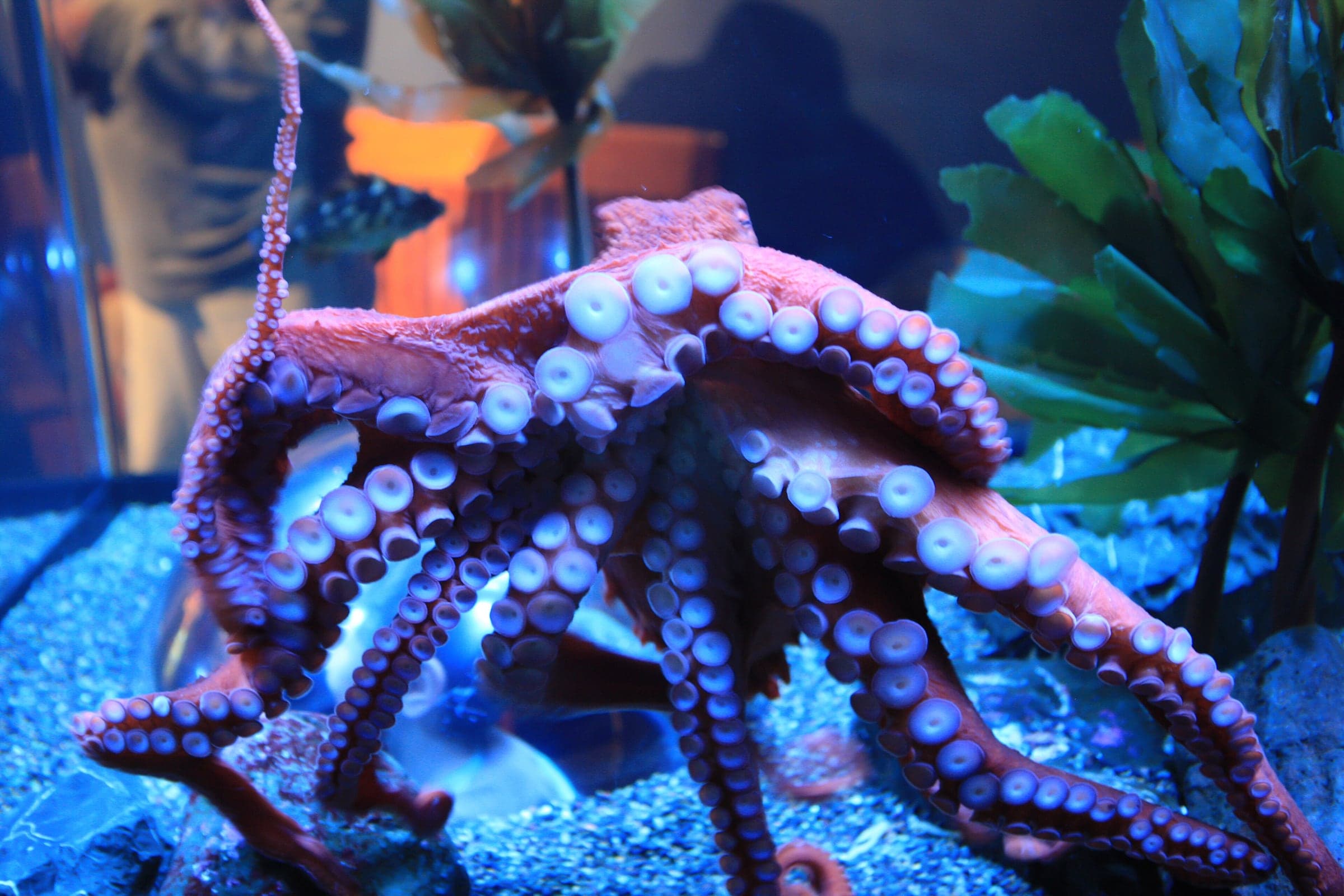
Aquarium keepers have long said that octopuses seem to have favorite people, and people they'd rather avoid. A 2010 study set out to test it.
The experiment
Researchers introduced eight giant Pacific octopuses to two people they had never met. Both people wore identical uniforms. Over two weeks, one person always fed the octopuses. The other always touched them with a bristly stick. Source Anderson et al., 2010(opens in a new tab)
What the octopuses did
By the end of the two weeks, the octopuses were reacting differently to the two people. Source Anderson et al., 2010(opens in a new tab)
Their skin showed a dark bar across the eyes more often with one person than the other. They reached their arms toward one person and away from the other. Even the direction they pointed their funnel, the tube they use to jet water, was different. The larger octopuses' breathing changed too. Source Anderson et al., 2010(opens in a new tab)
In other words, they had learned who was who, even though the two people looked almost exactly alike.
Why it matters
This tells us octopuses don't just react to people in general. They remember individuals and how those individuals treated them. The researchers noted that anyone working with octopuses should keep this in mind, since an octopus may respond to one person very differently than another. Source Anderson et al., 2010(opens in a new tab)
Next time you're at an aquarium, wave. Someone might remember you.
Bucky saysLiked this? Becoming an Octopedarian takes about 20 seconds. Join the movement
Sources
- Anderson, R. C., Mather, J. A., Monette, M. Q., & Zimsen, S. R. M. (2010). Octopuses (Enteroctopus dofleini) Recognize Individual Humans. Journal of Applied Animal Welfare Science 13(3), 261–272. doi:10.1080/10888705.2010.483892