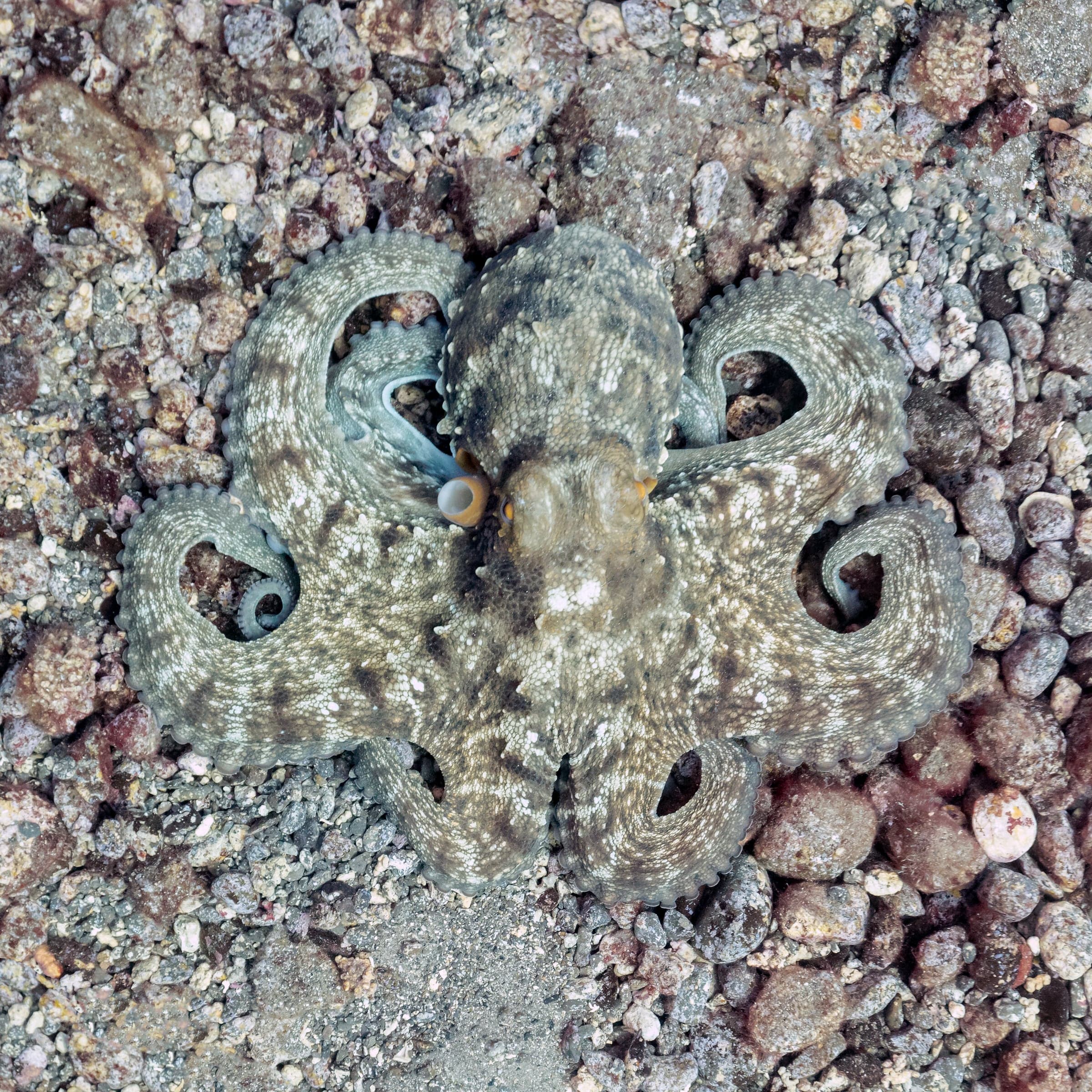
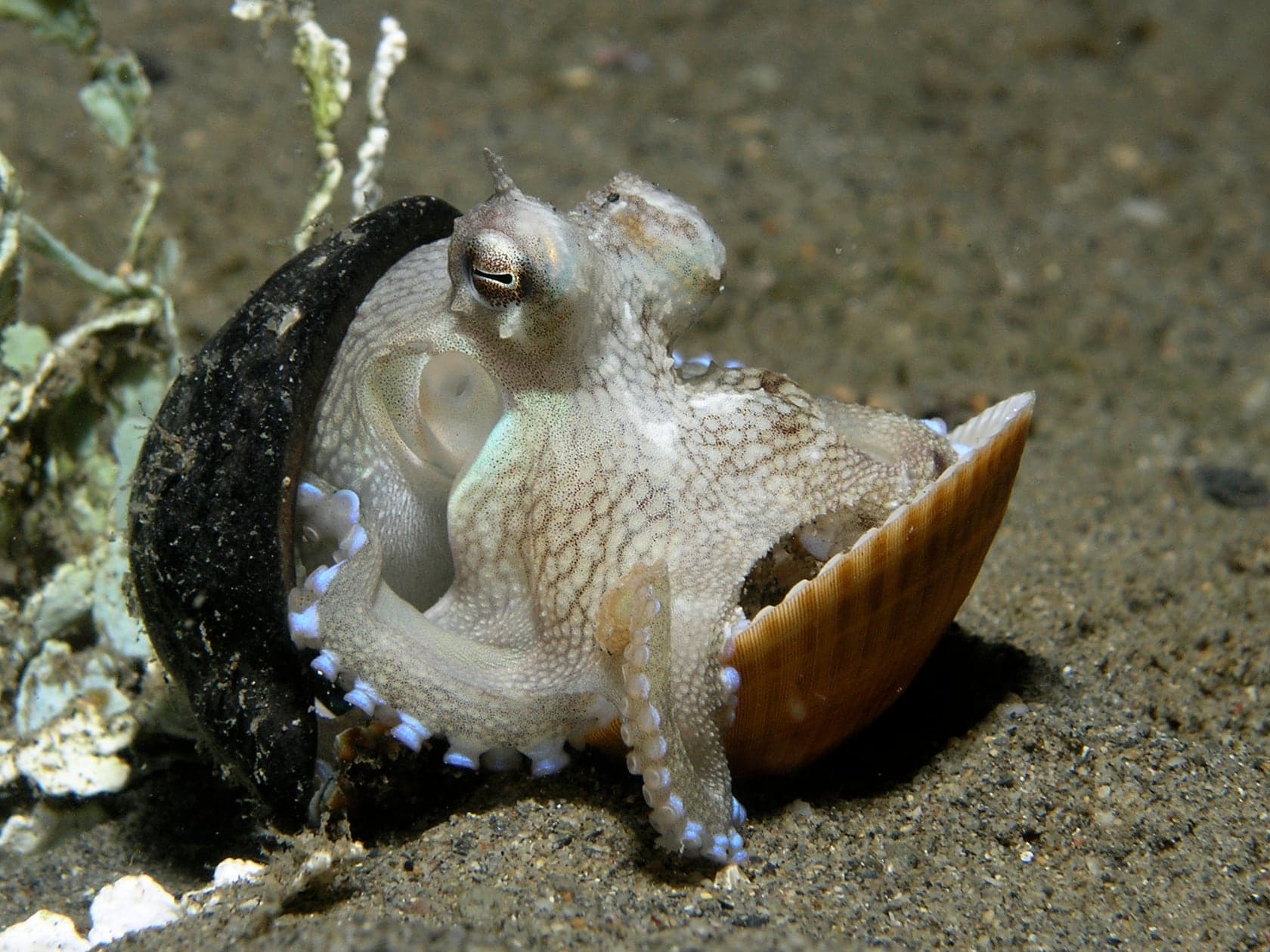
Bucky fact checkYes, octopuses really can do all of this. I checked the sources. One per arm.
01
They know who you are.
Giant Pacific octopuses treated a person who fed them differently from a person who poked them with a bristly stick, even when both wore identical uniforms. They remember how you treated them.
Octopuses learned to avoid a place where they had been hurt and to prefer one where they were given pain relief. Researchers say this suggests pain they actually feel, not just a reflex.
An octopus mother guards her eggs until they hatch, eating little or nothing, and most mothers die after that one brood. One deep-sea mother was watched guarding hers for 53 months, the longest brooding period known for any animal.
Researchers who watched octopuses over time found clear, lasting differences between individuals. Some were bold, some shy, some always busy. Every octopus has a personality of its own.
Octopuses have been seen jetting water at a floating bottle again and again, pushing it around their tank and catching it on the return. It meets the scientific criteria for play.
When octopuses sleep, they slip into an active stage where their skin flickers through the same patterns they show when awake, and their brain activity looks like waking. Scientists have compared it to REM sleep, when people dream.
🐙 Bucky says Last night I dreamt about a really good rock.
In lab studies, octopuses have learned to open closed jars to reach food inside, getting faster with practice, and to work out how to pull a puzzle box through a small opening.
So you won't see us claim an octopus is smarter than your dog. Here's how they actually measure up.
≈
As many neurons as a dog's thinking brain.
An octopus has about 500 million neurons. That's roughly as many as a dog has in its cerebral cortex, the part of the brain most linked to thinking, and about twice as many as a cat's.
In the same league as some animals with backbones.
In a major 2020 review, Cambridge researchers found that octopuses and their relatives have perception, learning and memory abilities comparable to some vertebrates.
Scientists gave cuttlefish, close relatives of octopuses, a version of the famous marshmallow test first designed for children. They held out up to two minutes for a better snack, the kind of self-control seen in chimpanzees, crows and parrots.
A dog's brain has about four times as many neurons in total. But its cerebral cortex, the part most linked to thinking, holds 430 to 630 million. That's about the same as an octopus's entire nervous system.
Dogs
Dogs can follow a person's pointing gesture to find hidden food.
Each dot is 10 million neurons. Counts come from published studies of individual animals and vary from one individual to the next. The octopus figure covers its whole nervous system; for other animals it's the whole brain. Neuron counts are a useful way to compare brains, but on their own they aren't a measure of intelligence.
Go deeper
The science, in a little more depth.
A very different kind of mind
Octopus intelligence evolved along a completely separate path from ours. An octopus has roughly 500 million neurons, and about two-thirds of them are in its arms, not its brain. Each arm can explore, grasp and react with a surprising degree of independence, while the central brain coordinates the whole animal.
Octopuses learn quickly and remember what they learn, including where safe burrows are hidden. In a classic, and still debated, 1992 study, octopuses that watched another octopus choose a particular object later tended to choose the same one themselves.
Octopuses can change the color, pattern and even the texture of their skin in a fraction of a second to match their surroundings. One species, the mimic octopus, goes further and impersonates other animals entirely.
The evidence increasingly says yes. In a 2021 study, octopuses avoided a chamber where they had experienced a painful injection and preferred one where they had received pain relief. That's behavior consistent with actually feeling pain, not just reflexively reacting to it.
A 2021 review commissioned by the UK government examined more than 300 scientific studies and found strong evidence that octopuses and other cephalopods are sentient. The UK's Animal Welfare (Sentience) Act 2022 now recognizes them as sentient beings. In the EU, cephalopods are protected under the rules governing animals used in scientific research.
In 2024, a group of leading researchers signed the New York Declaration on Animal Consciousness, stating there is at least a realistic possibility of conscious experience in cephalopod mollusks.
As demand for octopus grows, companies have explored farming them. Researchers writing in Issues in Science and Technology argued against it: octopuses are curious, solitary, intelligent animals poorly suited to barren captive conditions, and as carnivores they would need to be fed other animals, adding pressure on wild fish populations.
No. Octopedarians eat whatever they want, just not octopus. It's one specific choice about one remarkable animal.
I've eaten octopus before. Can I still join?+
Absolutely. So did plenty of us. You can choose to be a Born-Again Octopedarian. Changing your mind after learning something new is worth celebrating.
Are octopuses really that intelligent?+
Decades of research show octopuses solving problems, using tools, learning, playing and telling individual people apart. We link every claim on this site to its source so you can judge for yourself.
Does eating octopus make me a bad person?+
No. We don't do guilt here. Most of us didn't know how remarkable octopuses were until we looked into it. Learning something new and deciding differently is the whole point.
Does it cost anything to join?+
No. Membership is free. You get a member number, a membership card and a link to recruit friends.
Do I have to say anything to restaurants?+
Not at all. Ordering something else is enough. If you'd like to do more, our restaurant program will offer friendly, factual ways to help, never confrontation.
How do I know the science is real?+
Every claim links to its source, and we favor peer-reviewed research and official reports. If you think we've gotten something wrong, email science@octopedarian.com.
What about squid and cuttlefish?+
They're fascinating too, and much of the science on this page applies to cephalopods broadly. Our pledge is about octopus. What you do with the rest is up to you.