Meet an Octopus
Meet the coconut octopus
A small octopus that packs its own house for the road.
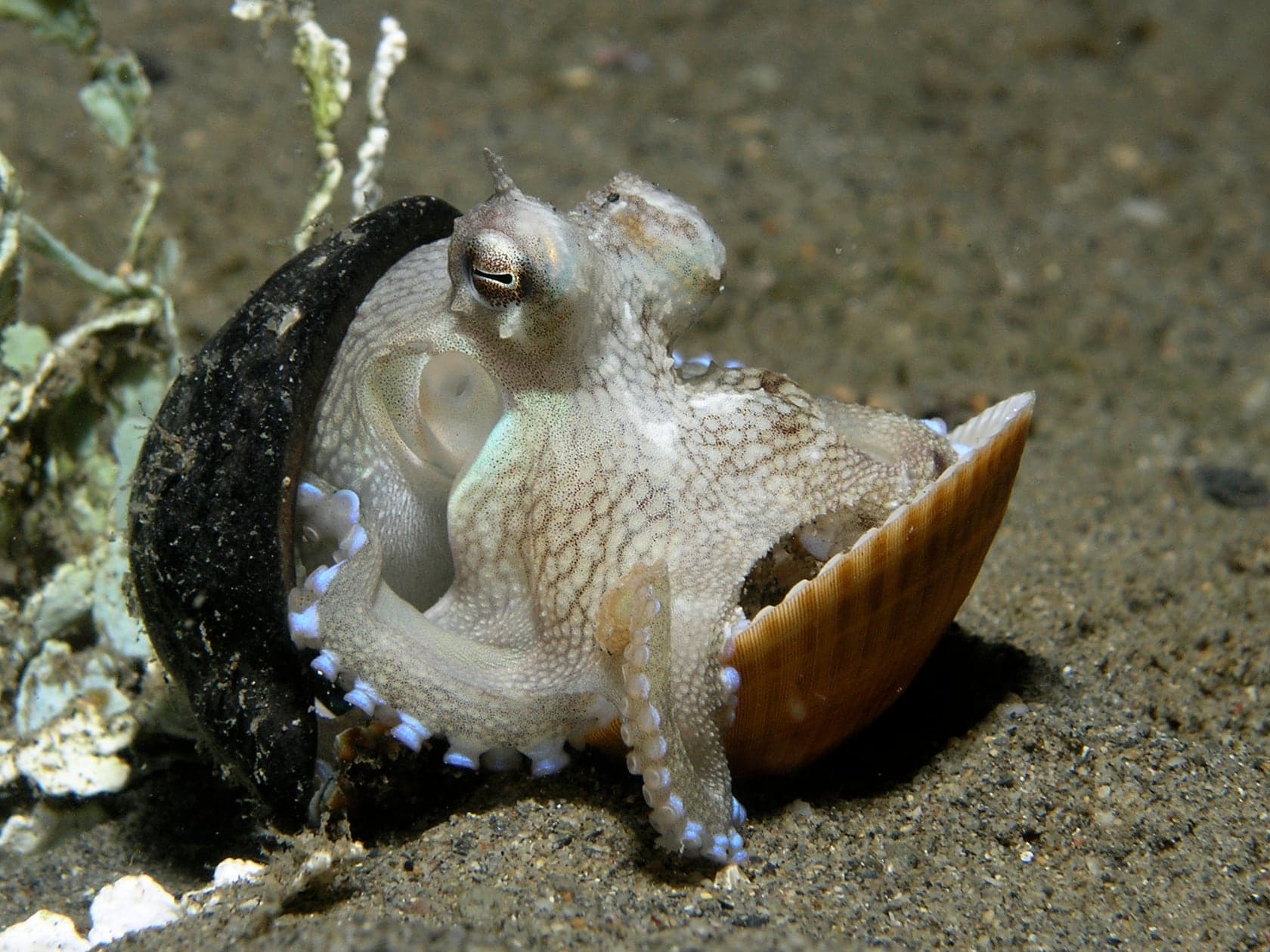
The veined octopus is a small, brown-and-cream octopus that lives on sandy, muddy seafloors in the tropical waters of the Indo-Pacific. Sand offers very little cover, so it has found a creative solution.
A house it carries
Researchers diving off Indonesia watched veined octopuses dig up discarded coconut shell halves, stack them, and carry them across the seafloor. Moving with a stack of shells isn't easy. The octopus walks awkwardly on stiffened arms, with the shells tucked underneath. Source Finn et al., 2009(opens in a new tab)
When it needs cover, it puts the halves back together and climbs inside, turning two pieces of trash into a portable shelter.
Why scientists call it tool use
Plenty of animals hide inside things. What made this different is the carrying. Lugging shells around gives the octopus no benefit in the moment, and it makes travel slower and clumsier. The payoff only comes later, when the octopus needs a place to hide. That's why the researchers described it as tool use. Source Finn et al., 2009(opens in a new tab)
What it tells us
Using an object now for a benefit later is one of the things that makes octopuses so interesting to scientists who study how animals think. It's also a good reminder of how much is still happening on parts of the ocean floor most of us never see.
The coconut octopus is one of the eight reasons octopuses are too smart to eat. You'll find the other seven on our science page.
Bucky saysLiked this? Becoming an Octopedarian takes about 20 seconds. Join the movement
Sources
- Finn, J. K., Tregenza, T., & Norman, M. D. (2009). Defensive tool use in a coconut-carrying octopus. Current Biology 19(23), R1069–R1070. doi:10.1016/j.cub.2009.10.052