Science
Arms with a mind of their own
Two-thirds of an octopus's neurons are in its arms. Here's what that means.
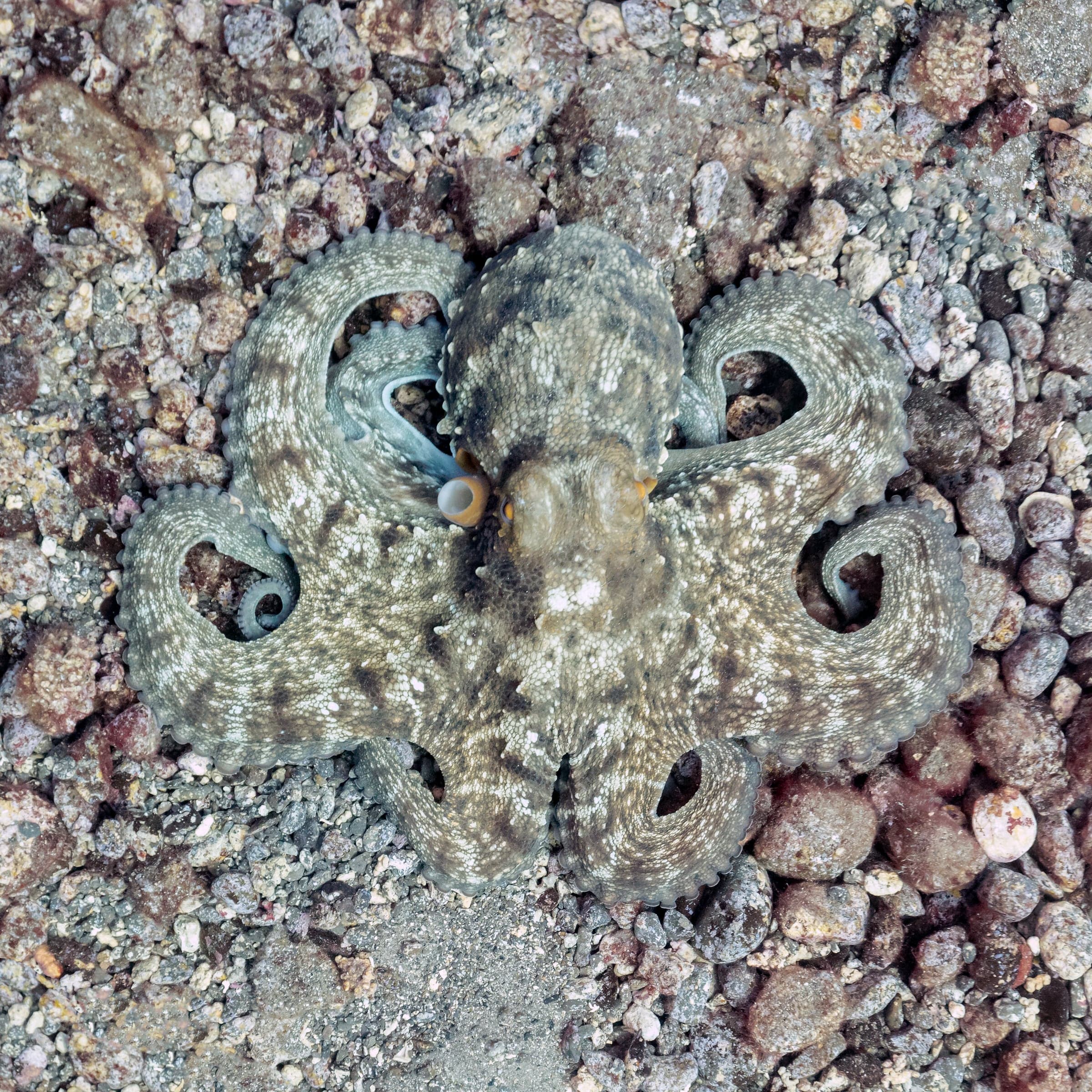
Imagine controlling eight long, boneless arms that can bend at any point, in any direction. That's the challenge an octopus solves every waking moment. Source Hochner, 2012(opens in a new tab)
Brains in the arms
An octopus has roughly 500 million neurons, and about two-thirds of them aren't in its brain at all. They're in its arms. Source Hochner, 2012(opens in a new tab)
Scientists think this is part of the answer to that control problem. Rather than the brain micromanaging every movement, a lot of the work is handled locally, by the arms themselves. Source Hochner, 2012(opens in a new tab)
A reach without the brain
In one striking experiment, researchers found that an arm whose connection to the brain had been severed could still produce a reaching movement almost identical to a normal one. Their conclusion was that the basic program for that movement lives in the arm's own nerve circuits. Source Sumbre et al., 2001(opens in a new tab)
In everyday life, the brain and arms work together. The brain decides what to do, and the arms take care of much of how to do it. Source Hochner, 2012(opens in a new tab)
Intelligence in the whole body
Neuroscientist Binyamin Hochner describes the octopus as an example of embodied intelligence, where smart behavior emerges from the brain, body and environment working together, rather than from the brain alone. Source Hochner, 2012(opens in a new tab)
It's a very different design from ours, and a reminder that there's more than one way to build a mind.
Bucky saysLiked this? Becoming an Octopedarian takes about 20 seconds. Join the movement
Sources
- Hochner, B. (2012). An Embodied View of Octopus Neurobiology. Current Biology 22(20), R887–R892. doi:10.1016/j.cub.2012.09.001
- Sumbre, G., Gutfreund, Y., Fiorito, G., Flash, T., & Hochner, B. (2001). Control of octopus arm extension by a peripheral motor program. Science 293(5536), 1845–1848. doi:10.1126/science.1060976